November 23, 2026
Foreign-Owned US Company? Don't Miss Form 5472 (and What's Changed With BOI)

Setting up a US LLC or corporation is easy for Australian and other non-US founders. Staying compliant is where many come unstuck. The most expensive mistake we see is missing Form 5472, a filing that applies even if your company earned nothing all year.
Form 5472 is an information return for US companies that are 25% or more foreign-owned and have reportable transactions with their foreign owner or related parties. It applies to:
Reportable transactions are broad. They include money you put into the company to open a bank account or pay formation fees, loans to or from the owner, distributions, and payments for services between related parties. In practice, almost every foreign-owned company has something to report.
For a calendar-year company, Form 5472 for 2026 is due April 15, 2027, together with the Form 1120 or pro forma 1120. A six-month extension to October 15 is available by filing Form 7004 on time.
Foreign-owned single-member LLCs can't use standard e-filing for the pro forma return; it's sent by mail or fax under IRS instructions. Make sure the LLC has an EIN well before the due date.
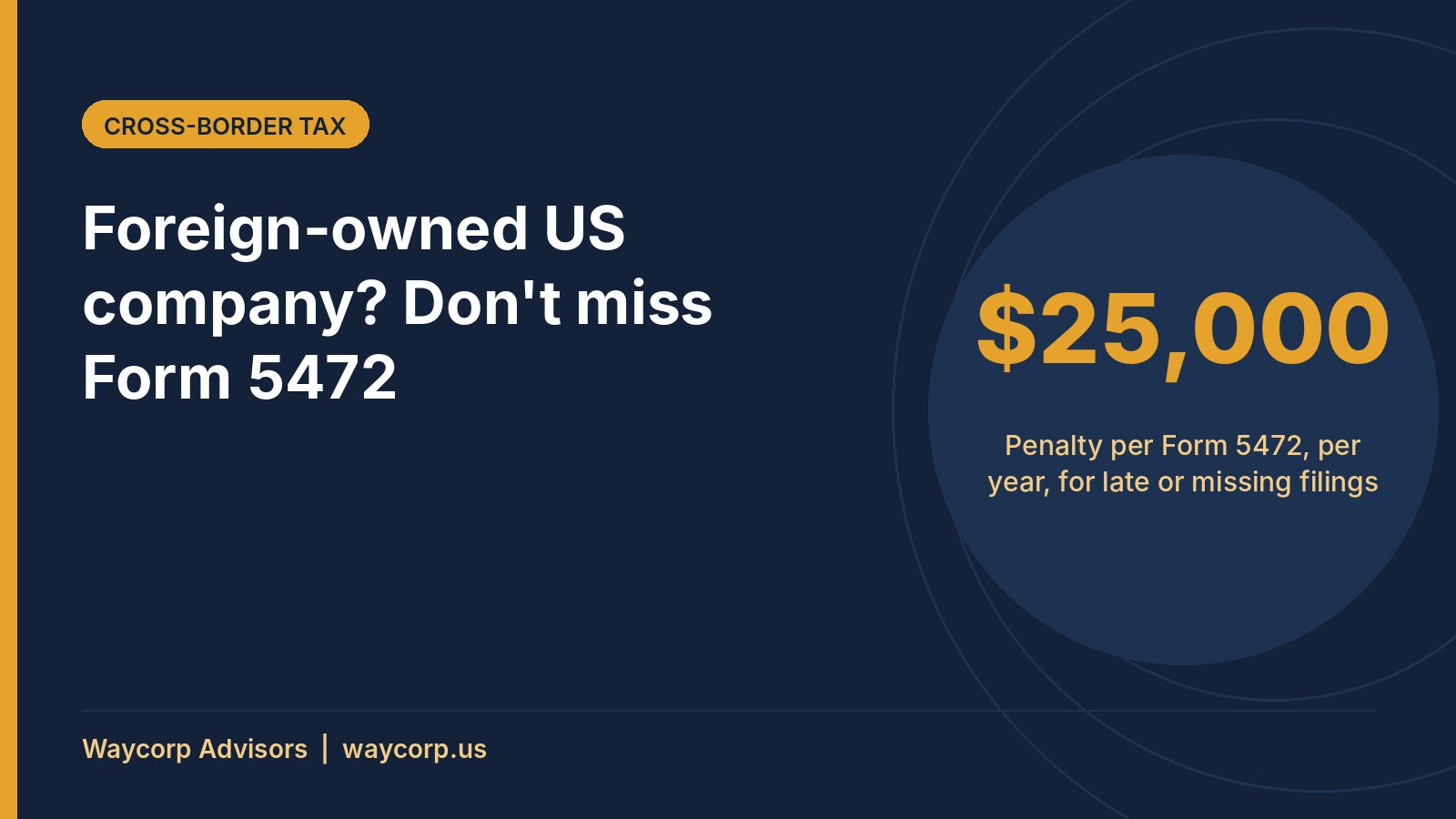
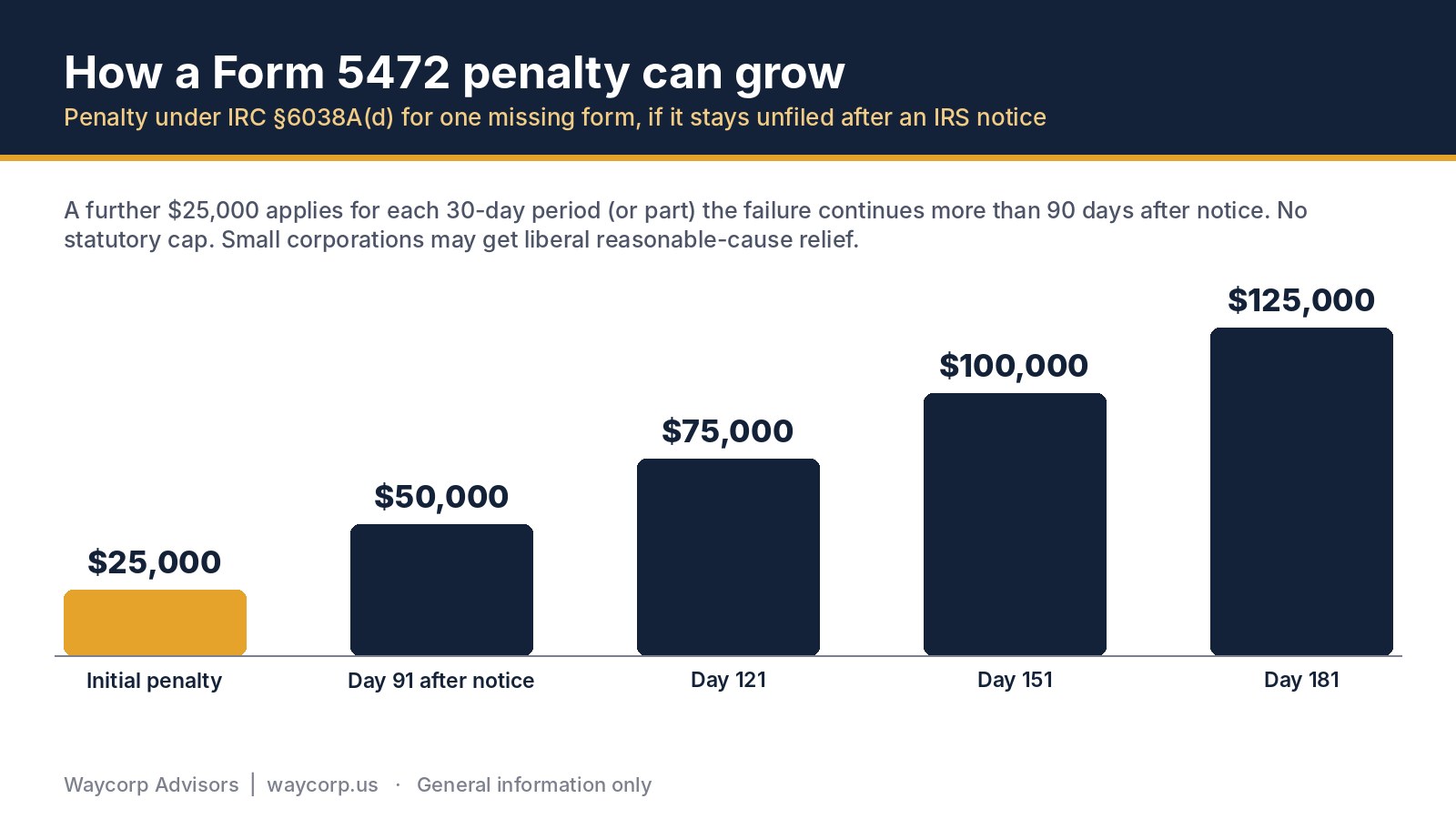
The penalty for not filing, filing late or filing a substantially incomplete Form 5472 is $25,000 per form, per year. If the IRS sends a notice and the form still isn't filed within 90 days, a further $25,000 applies for each 30-day period it remains outstanding.
When a late Form 1120 arrives with a Form 5472 attached, the IRS usually assesses the $25,000 automatically, typically by sending a CP215 notice, before anyone has looked at why the filing was late. It sounds alarming, but many of these penalties are later removed. The National Taxpayer Advocate has reported that roughly three in four of these automatically assessed international penalties end up abated.
The penalty doesn't apply if the failure was due to reasonable cause and not willful neglect. For small corporations, the regulations go further: under the small-corporation provision in Treas. Reg. §1.6038A-4(b)(2)(ii), reasonable cause "shall be applied liberally" where the company meets all four of these conditions:
In Chief Counsel Advice CCA 202617012, released on April 24, 2026, the IRS Office of Chief Counsel confirmed how this works in practice. A company that cooperates promptly and fully and gives the IRS a written statement, signed under penalties of perjury, showing it meets these conditions should generally be found to have reasonable cause. The CCA isn't binding precedent and relief still isn't automatic, but it gives small foreign-owned companies that made a genuine mistake a clear path.
One more reason to fix missed filings: while a required Form 5472 is outstanding, the statute of limitations stays open for the company's whole return.
If you've missed earlier years and haven't heard from the IRS, file now with a reasonable-cause statement attached. A voluntary late filing with a well-documented explanation is the strongest position you can be in.
Under the Corporate Transparency Act, US companies were originally required to report their beneficial owners to FinCEN. In August 2026, FinCEN issued a final rule that permanently removed BOI reporting for companies formed in the US, including US LLCs owned by Australians. BOI reporting still applies to foreign companies registered to do business in a US state, such as an Australian Pty Ltd registered as a foreign entity in Delaware or California.
Yes. Since 2017, a US single-member LLC wholly owned by a foreign person must file Form 5472 attached to a pro forma Form 1120 each year it has a reportable transaction, even if it had no income.
$25,000 per form, per year. If the form is still not filed 90 days after an IRS notice, a further $25,000 applies for each 30-day period it remains outstanding.
Often, yes. The penalty doesn't apply where there was reasonable cause. For small corporations with overall gross receipts of $20 million or less, limited US contact, no knowledge of the requirement and prompt compliance, Treas. Reg. §1.6038A-4(b)(2)(ii) says reasonable cause is to be applied liberally, as confirmed in CCA 202617012. First-time abatement generally does not apply.
No. Since FinCEN's August 2026 final rule, companies formed in the United States, including foreign-owned US LLCs, no longer file BOI reports. Foreign companies registered to do business in a US state still do.
Waycorp works on both sides of the Pacific, with offices in Sydney and Dover, Delaware. We form US companies, act as their accountants, and prepare Forms 1120 and 5472 every year. Email team@waycorp.us or call +1 (302) 440 1465.
This article is general information only and is not tax or legal advice for your specific situation.
Financial Insights
November 23, 2026
Five practical year-end tax planning moves for US small business owners before December 31, 2026, including bonus depreciation, Section 179 and QBI.